


- On 11 and 12 November, CIHEAM Zaragoza will put the spotlight on multilateral agrifood cooperation by hosting an international symposium together with the Spanish Agency for International Development Cooperation (AECID).
- The rapidly evolving geopolitical landscape calls for a reassessment of existing models and a reorientation of agri-food development cooperation strategies.
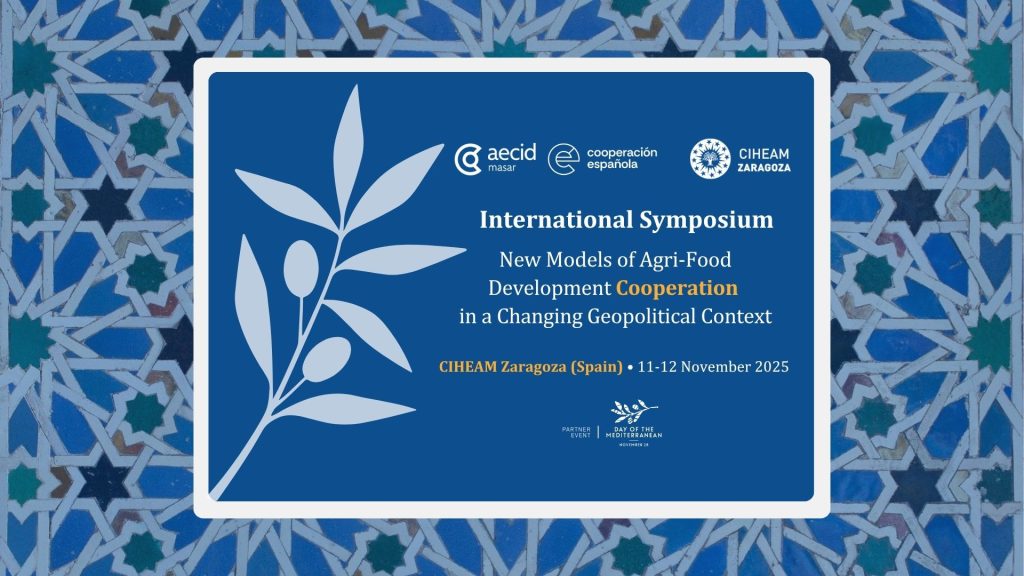
The International Centre for Advanced Mediterranean Agronomic Studies in Spain (CIHEAM Zaragoza) will host an international symposium on 11 and 12 November to discuss new directions for agri-food development cooperation in a changing context of geopolitical crisis.
The event will gather experts from European agencies, international and local development NGOs, officers from multilateral organisations, academics, researchers and representatives of several Spanish administrations. Together they will examine the implications of current geopolitical crises and explore new models to guide the future of development cooperation.
Organised by CIHEAM Zaragoza with the support of the Spanish Agency for International Development Cooperation (AECID), the symposium is also one of the events that will celebrate the Day of the Mediterranean (28 November) declared by the Union for the Mediterranean (UfM) to foster a common Mediterranean identity, cultural exchange and cooperation.
International cooperation in agrifood systems
Guaranteeing food security remains one of the key objectives of international development cooperation. Providing the necessary means, infrastructures and the technical and professional expertise to manage agrifood resources is an essential element of many development cooperation initiatives across the world.
It is essential to adapt the strategies of international, multilateral, national and local bodies to the specific needs of each territory and ensure that these resources are managed appropriately to achieve long-term sustainability.
In today’s context of humanitarian and geopolitical instability, reassessing the present situation and future prospects for agrifood development cooperation has become more urgent than ever.
Therefore, the Zaragoza symposium will address the sector’s key challenges and propose new models for international cooperation through keynote lectures, round-table discussions and case studies.
The present and future of agrifood cooperation
The programme will be structured in plenary sessions:
- Session I: When the world changes: rethinking international development cooperation in the new geopolitics.
- Session II: Adapting for impact: the role of European development agencies in a changing world. Reshaping multilateral and bilateral agri-food cooperation.
- Session III: Development cooperation from the perspective of southern and eastern Mediterranean countries’ needs.
- Session IV: The role of NGOs in the new development cooperation architecture.
- Session V: Civil society in developing countries: perspectives on current and future development cooperation.
- Session VI:
- Part 1: Spain’s decentralised cooperation landscape: current status and emerging trends. The regional approach.
- Part 2: Spain’s decentralised cooperation landscape: current status and emerging trends. The local approach.
Registration
In-person participation is limited and upon invitation. All sessions will be open to online participation (subject to registration).
CIHEAM Zaragoza has been promoting cooperation since 1969 to address the challenges of Mediterranean agri-food systems. Based on a wide range of collaboration agreements with diverse institutions, it has developed an extensive network to strengthen capacity building and transfer of knowledge to countries with the greatest needs. Through these efforts, the organisation has become a strategic meeting point for leading actors in Mediterranean agri-food cooperation, providing a platform to debate new models, forge transformative partnerships, and design innovative projects.