






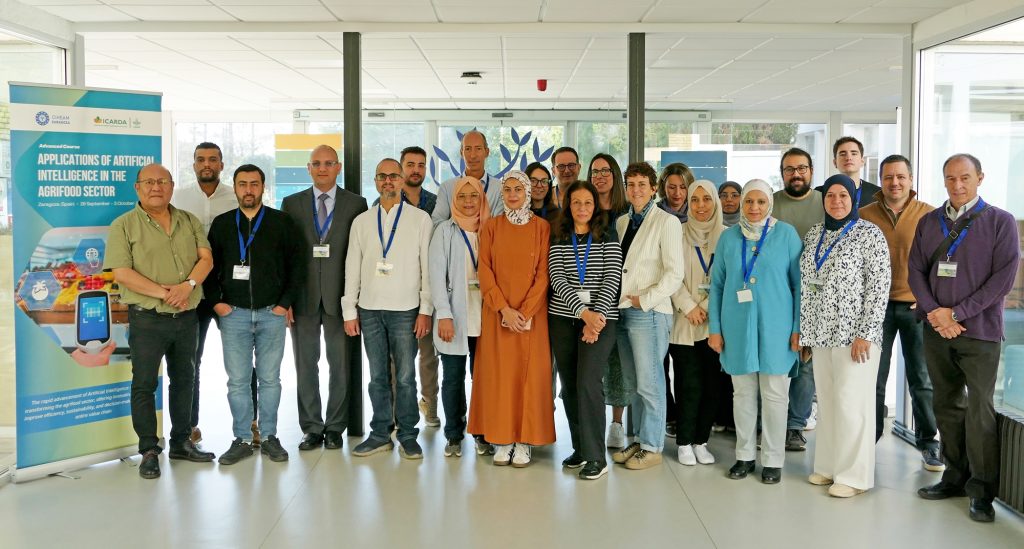
- CIHEAM Zaragoza and ICARDA have organised an advanced course on applications of artificial intelligence in the agrifood sector, attracting 40 professionals from 12 countries
9 October 2025.- Artificial intelligence (AI) is transforming the agrifood sector across the whole value chain, from genetic improvement of seed and quality control of the end product up to the retail stage. This transformation is the main focus of the course "Applications of Artificial Intelligence in the Agrifood Sector", jointly organised by the International Centre for Advanced Mediterranean Agronomic Studies in Spain (CIHEAM Zaragoza) and the International Center for Agricultural Research in the Dry Areas (ICARDA), that took place from 29 September to 3 October 2025.
The training event gathered 40 professionals from 12 countries across Europe, Africa, the Middle East, and America (Algeria, Egypt, Italy, Lebanon, Mexico, Morocco, Nigeria, Palestine, Portugal, Spain, Tunisia and Türkiye).
The course offered a comprehensive understanding of how to apply artificial intelligence in the agrifood sector, and provided insight into how to evaluate the requirements, opportunities, and risks associated to these technical solutions.
Greatest impact of AI
Lluís Echeverria Rovira, researcher from the Unit of Applied Artificial Intelligence of Eurecat (Technological Centre of Catalonia) and scientific coordinator of the course, points to precision farming and the agrifood industry as two key areas where artificial intelligence is having the greatest impact: from farm to fork.
Echeverria explains more about where this impact is occurring: “In the scope of agriculture, these solutions enable us to detect exactly what the needs of each crop are and to apply the exact amounts of water and fertilisers, whilst in the industrial sector, AI facilitates predictive maintenance and optimisation of production processes, quality control and food safety measures”.
Digital twins and synthetic data
Francisco Javier Zarazaga-Soria, professor from the Department of Computer Science and Systems Engineering of the University of Zaragoza, addressed the role of digital twins - digital models of real agricultural situations that enable users to simulate future scenarios to improve decision-making. By combining AI and data analytics, these models can improve farm management in the context of climate uncertainty.
However, Zarazaga-Soria pointed out that lack of data in the farming sector is still the main challenge. "Farming is not like a car manufacturer. Agriculture produces only once or twice a year". For this reason, his research group is working on the generation of synthetic data based on simulations that enable them to build new scenarios and enrich predictive models.
Knowledge as a driver of responsible innovation
The training and knowledge-sharing event not only raised awareness of the technological tools available, but also provided an opportunity to reflect upon the ethical, social and regulatory implications of their implementation in order to advance towards a more efficient, safer and sustainable agrifood system.
Zarazaga-Soria concluded by naming two main obstacles that go beyond technological issues. The first concerns legislation: setting the grounds for these systems to operate according to regulations. The second barrier is a social one: "To what extent are we prepared to allow a fully autonomous system, without human intervention, to produce our food in the near future?".